

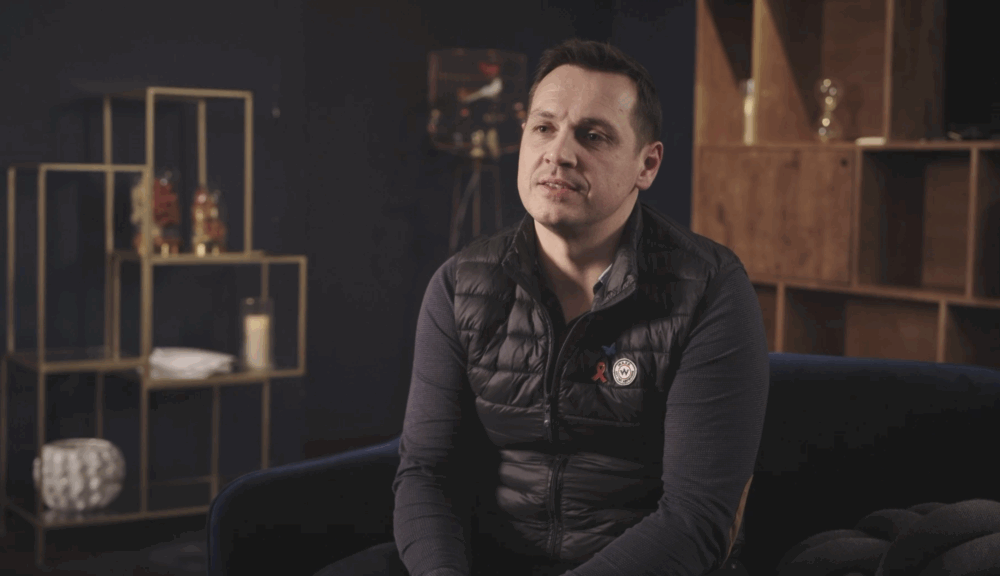
One case of leukemia in a family is already unthinkable. Two cases of leukemia affecting two children from the same siblings, three years apart — this is a reality that very few families have experienced. Yet Yann Decker has lived through it. As the father of Noah and Elsy, he shares his story in our Facing Cancer series, recounting an extraordinary journey and a fight that took him far beyond the walls of the hospital.
Noah, five years old: the first diagnosis
In 2020, Noah was five years old when he was diagnosed with B-cell acute lymphoblastic leukemia. For Yann, his wife Émilie, and their family, it was the brutal shock that all parents of children with cancer experience: confusion, fear, and the forced entry into a medical world they had never known before.
“We’re not experts. When we enter this world, we know absolutely nothing and we just try to pick up bits of information here and there.”
Yann describes with clarity this period of disorientation — common to so many families — when you move forward blindly, trying to understand a universe with its own codes, its own protocols, and its own language.
“We’re not experts. When we enter this world, we know absolutely nothing.”
Three years later: Elsy, the same diagnosis
Then comes the unimaginable. Three years after Noah’s diagnosis, his sister Elsy also develops B-cell acute lymphoblastic leukemia — exactly the same disease as her brother.
Two children. The same family. The same leukemia. This is no longer a coincidence that can simply be dismissed. For Yann and Émilie, this recurrence raises unavoidable questions: why? Is it genetic? Is there a common factor? A risk of transmission? A risk of relapse for their children and for future generations?
“It led us to ask many questions about the origin of these diseases.”
These questions are not just those of worried parents. They are legitimate scientific questions that medicine does not always yet know how to answer. And it is precisely this lack of answers that pushed Yann to take action.
The France Genomic Medicine Plan: the fight to enter the system
While searching for answers, the family heard about the France Genomic Medicine Plan 2025 — a national program aimed at integrating genomics into the care pathway of certain patients. For Yann, this represented a concrete lead: what if genetic analysis could explain why two children from the same family developed the same leukemia?
The family prepared an application and applied to the program. A few months later, the answer came: rejected. The family did not meet the criteria of the current protocol.
“It upset us a little. At that moment, our motivation came partly from anger.”
Yann could have kept that anger to himself. Instead, he chose to turn it into momentum. The family spoke publicly through a press release. The media picked up the story. Yann sought meetings at the highest level — even reaching Madame Macron, who directed them toward Imagine for Margo.
Eventually, the case was reassessed. The family finally learned they would be able to join the France Genomic Medicine Plan 2025.
Why this genetic question matters
The Decker family’s situation raises a question that pediatric oncology research is only just beginning to seriously explore: are there genetic factors that predispose certain children — or certain siblings — to develop leukemia?
Today, the vast majority of pediatric cancers are considered sporadic, meaning non-hereditary. But cases like Noah and Elsy’s raise important questions. Understanding the genetic mechanisms involved could potentially lead to less aggressive treatment protocols, better monitoring of at-risk siblings, and answers for families who, like Yann’s, live with uncertainty.
This is exactly the type of research supported by Imagine for Margo: ambitious projects dedicated exclusively to childhood cancers, seeking not only to improve treatments, but also to better understand these diseases.
“If you don’t do it, no one will do it for you”
Yann’s message is that of a man who has transformed his pain into action. He is not only speaking to families affected by pediatric cancer — he is speaking to anyone facing a wall and hesitating to overcome it.
“If you have convictions and ambitions, it will never be easy, but you must never give up.”
For Yann, his commitment to Imagine for Margo is the natural extension of this fight. Because advancing research, challenging institutional barriers, and giving families a voice all require resources, perseverance, and a community that refuses to give up.
“When you want to move a system forward, you find the energy you need. And when it’s for our children — that’s what matters most.”
Go, fight and win. For Noah. For Elsy. And for all children who deserve answers.
Help us fight pediatric cancer by making a donation.